
Zone 03, hips and legs
Heavy legs,
short stride
Hip rotation drops, legs stop clearing between sessions, and squat depth and stride length go first. This is where treatment and training meet.
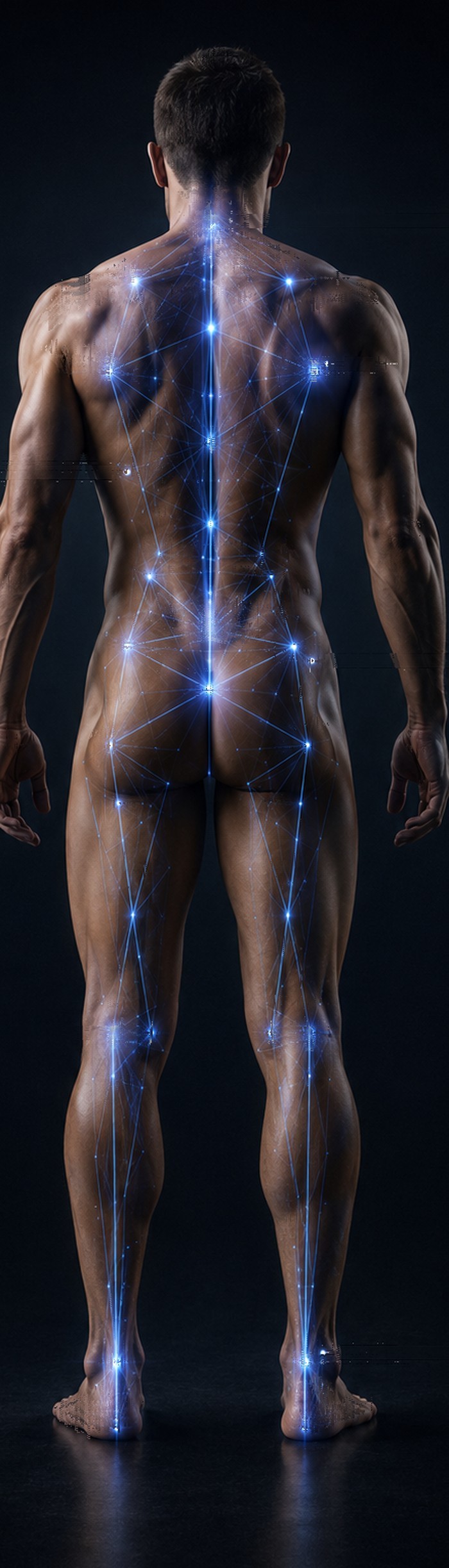
What is actually happening
Two things stack up. Sitting reduces hip rotation and extension, because the joint spends most of the day at ninety degrees and never visits the ends of its range. Then training loads a body working from that reduced range. The tissue takes on more work than it should, and recovery between sessions gets slower.
The first signs are rarely pain. They are performance signs: depth in the squat quietly reducing, stride shortening on longer runs, a warm up that takes longer than it used to.
How it usually presents
- Squat depth reducing, or knees drifting inward under load
- Legs still heavy two days after a hard session
- Hip flexors that feel pinched at the front of the joint when driving the knee up
- Calves and quads that stay tender well beyond the usual window
- One side that consistently feels different from the other
The treatment route
Assessment. Hip internal and external rotation, hip extension, ankle dorsiflexion and a comparison between sides. Ankles are checked because a stiff ankle drives compensation the whole way up the chain.
Release. Deep tissue work through the glutes, deep hip rotators, hip flexors, quads, adductors and calves, prioritised by what the assessment found rather than by what is sore.
Rebuild. Loaded mobility work rather than passive stretching. Range that is not loaded does not stay, which is why we do the loading rather than just the stretching.
Return. Where treatment sits in your training week, and how to schedule it around heavy blocks and events so it supports the training rather than interrupting it.
Timing around training
Deeper work leaves tissue mildly tender for a day or two. Schedule it after a hard session or on a rest day, and keep at least three days between deep work and a competition or race. If you have an event coming up, say so when you book and the session will be adjusted.
Questions
Before you book
Will this help my squat depth?
Frequently, yes, where the restriction is soft tissue or hip range rather than bony structure. The assessment tells us which it is, and if depth is limited by hip anatomy rather than tissue, you will be told rather than sold more sessions.
How soon before a race or competition should I book?
Deeper work is best three to five days out, so any tenderness has cleared. Lighter flushing work can be done closer to the day. Do not book your first ever deep tissue session the day before an event.
Can massage help with recurring hamstring tightness?
Often the hamstring feels tight because it is being lengthened by a pelvis that is tilted forward, not because the muscle is short. Stretching it harder rarely helps, which is why the assessment looks at the pelvis first.
Is this useful on a rest day or a training day?
Either works. Many clients prefer the day after a hard session, or on a rest day before a heavier block. What matters more is consistency than the exact slot.
Ready to change the pattern?
Book an assessment and treatment, and get a plan you can actually keep to.